
- This event has passed.
Computational Chemistry Days 2025
2 June 2025 @ 1:00 pm - 3 June 2025 @ 12:00 pm

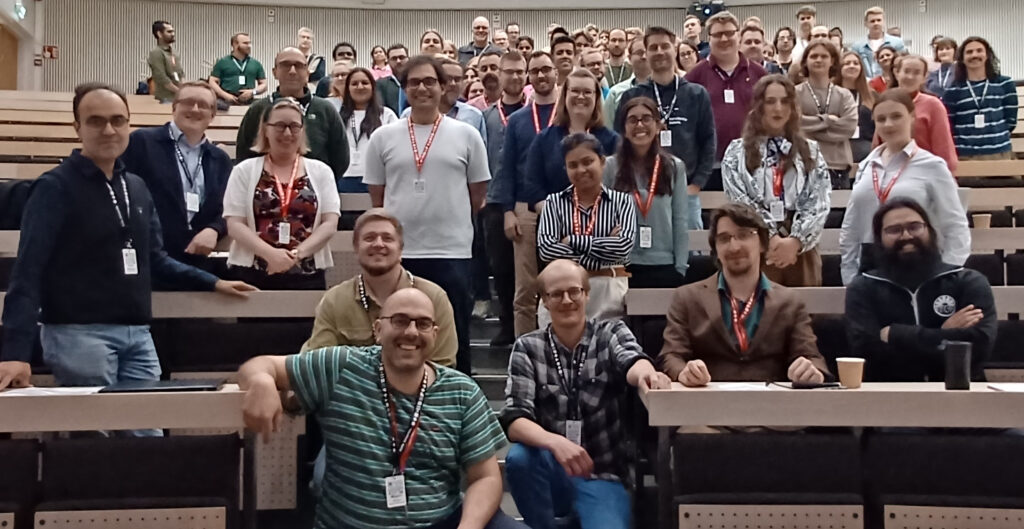
The Computational Chemistry Days is the main annual event of the computational chemists and materials scientists of Finland. The event has a well-established tradition and serves the purpose of bringing the national community together. Its role to keep researchers of different chemistry (and related) departments in Finnish universities in contact with one another cannot be overstated. This event showcases current trends in computational chemistry research, enables kickstarting of collaborative efforts and allows emerging researchers to advertise their work to the national community. Topics vary widely and cover the thematic areas of computational chemistry rather comprehensively, except for perhaps continuum modeling: organic and inorganic materials chemistry, molecular modeling, electrochemistry and electrocatalysis, soft- and bio-materials modeling, polymers, etc. Methodologically, atomistic modeling is usually best represented, density functional theory being the most popular technique, followed by force field simulations and, more recently, machine learning potentials. Coarse-grained models are also usually represented. Sampling techniques include molecular dynamics, Monte Carlo, enhanced sampling, structure search algorithms, transition-state theory, etc.
In 2025, the Department of Chemistry and Materials Science at Aalto University takes the baton from University of Jyväskylä, which organized the 2024 edition, and organizes the event jointly by the four computational groups that operate at the department. We will continue the tradition of giving the stage to researchers at all career levels. The event is informal and short, although relatively large in size, since it caters to (and aspires to gather) the whole Finnish community. Since this year we are back to the metro area, and having a large local community present, we estimate a particularly high attendance from across Finland. The event has short sessions and many breaks, to foster networking.
Invited speakers
 Prof Fernanda Duarte, University of Oxford (UK)
 Prof Karoliina Honkala, University of Jyväskylä
 Prof Matti Javanainen, Tampere University
 Dr Konstantinos Konstantinou, University of Turku
 Dr Petra Vasko, University of Helsinki
 Dr Rasmus Kronberg, CSC – IT Center for Science
Program
Download a PDF copy of the program.
The program starts on Monday 2 June 2025 after lunch (13:00) and ends on Tuesday 3 June before lunch (12:20). The whole event takes place at the Aalto University School of Chemical Engineering main building, Kemistintie 1, Espoo. The lecture hall A305 (Ke1) will hold all the oral presentations while the poster session and coffee breaks will take place just outside the lecture hall. The idea is to allow for train travel in the morning from the main Finnish cities to minimize the financial cost to participants of attending the conference (only one overnight hotel stay).
| Monday 2 June | Tuesday 3 June | ||
| 13:00 – 13:10 | Welcome speech by organizers | 9:00 – 9:40 | Invited: Fernanda Duarte (U. Oxford) – “Beyond static DFT: Modelling Chemical Reactions in Solution with MLIPs” |
| 13:10 – 13:40 | Invited: Matti Javanainen (U. Tampere) – “Molecular insights into the Sec61/TRAP translocon functions” | 9:40 – 10:10 | Invited: Konstantinos Konstatinou (U. Turku) – “Athermal bond-breaking pathways in amorphous phase-change memory materials” |
| 13:40 – 14:00 | Contributed: Samuli Ollila (VTT) – “Towards a Quality-Evaluated Simulation Databank for Intrinsically Disordered Proteins” | 10:10 – 10:30 | Contributed: |
| 14:00 – 14:20 | Contributed: Arun Kumar Kanakati (U. Jyväskylä) – “Simulating Nuclear Quantum Effects in Electronic Strong Coupling” | 10:30 – 11:00 | Coffee break |
| 14:20 – 14:50 | Coffee break | 11:00 – 11:30 | Invited: Karoliina Honkala (U. Jyväskylä) – “Advanced DFT calculations for modelling electrocatalytic systems at constant potential” |
| 14:50 – 15:20 | Invited: Petra Vasko (U. Helsinki) – “On the Mechanisms of Transition Metal-Free Transformations” | 11:30 – 11:50 | Contributed: Timo Weckman (U. Jyväskylä) – “Comparative study of metal porphyrins for CO2 reduction and cation effect” |
| 15:20 – 15:40 | Contributed: Akseli Mansikkamäki (U. Oulu) – “Magnetic Properties and Unconventional Bonding in Organometallic Complexes of Lanthanides and Actinides” | 11:50 – 12:10 | Contributed: Saara Sippola (U. Turku) – “Active Learning Structure Search Study of 17-Beta-Estradiol Adsorption on Graphene” |
| 15:40 – 16:00 | Contributed: Kim Eklund (Aalto U.) – “Pyroelectric properties of ordered Pb[Zr0.5Ti0.5]O3“ | 12:10 – 12:20 | Closing remarks and farewell |
| 16:00 – 16:20 | Break | ||
| 16:20 – 16:50 | Invited: Rasmus Kronberg (CSC) – “Roihu supercomputer and other updates from CSC” | ||
| 16:50 – 17:10 | Contributed: Mandira Das (U. Turku) – “Decoding Aerosol Surface Chemistry: Insights from XPS Spectra via DFT and Machine Learning” | ||
| 17:10 – 17:30 | Contributed: Lauri Franzon (U. Helsinki) – “Discovering the elusive mechanism of accretion product formation from RO2 + RO2“ | ||
| 17:30 – 19:00 | Poster session (snacks and refreshments served) | ||
Posters
| # | Details |
| 1 | Dániel Nagy (U. Oulu) – “Single Molecular Magnets as Quantum Processors” |
| 2 | Qian Wang (U. Helsinki) – “Changing aromatic properties through stacking” |
| 3 | Hugo Åström (U. Helsinki) – “Atomic Confinement Potentials” |
| 4 | Atte Sillanpää (CSC) – “BioExcel-3 CoE supports the biomolecular simulation community on using HPC” |
| 5 | Efstathia Mantzari (Aalto U.) – “Computational studies on the conformational landscape of mussel and barnacle adhesive proteins” |
| 6 | Artem Glova (Aalto U.) – “Representation learning for glass transition detection in polymers using simulations” |
| 7 | Tiia Jacklin (U. Oulu) – “Quantum-mechanical treatment of thermal effects on NMR of buckminsterfullerene: negative thermal expansion, chemical shift and isotope shifts” |
| 8 | Vivek Sharma (U. Helsinki) – “A histidine molecular switch in the proton pump of respiratory complex I” |
| 9 | Fabio Priante (Aalto U.) – “Metadynamics Exploration of Fibronectin 10FNIII Unfolding Pathways” |
| 10 | Felix Eurasto (U. Helsinki) – “Machine Learning analysis of GPCR structural data reveals activity classes” |
| 11 | Ossi Laurila (U. Oulu) – “Path integral molecular dynamics with machine learning models for quantum effects of C60“ |
| 12 | Izabella Leszczyńska (Jerzy Haber Institute) – “Phase separation process in ternary polyelectrolyte mixtures” |
| 13 | Luukas Nikkanen (U. Helsinki) – “NEO calculations need uncontracted electronic basis set for quantum protons” |
| 14 | Amiel Abettan (U. Helsinki) – “Structural dynamics of mitochondrial supercomplexes” |
| 15 | Richard Jana (Aalto U.) – “Carbon nano tube growth on Fe nano particles” |
| 16 | Kaveh Farshadfar (Aalto U.) – “Mechanistic Evaluation of the Gold-Catalyzed Heck-Like Reaction: Allylic Deprotonation as a Key Step” |
| 17 | Yanzhou Wang (Aalto U.) – “Density dependence of thermal conductivity in nanoporous and amorphous carbon with machine-learned molecular dynamics” |
| 18 | Wilin Julian Sari (U. Helsinki) – “Hydration Mechanisms of Ternary Complex Formation of Dimethyl Sulfide by Hydroxyl Radical via Hydrogen” |
| 19 | Gabriel Debais (Aalto U.) – “A model for predicting polyelectrolyte self-assembly in solution: effects of pH, salt concentration, and mixing ratio” |
| 20 | Tirthonkor Saikia (U. Helsinki) – “Multiwavelet-based density functional calculations with MRChem and LibXC” |
| 21 | Milan Kunnatholy Babu (U. Helsinki) – “NEO-DFT Study of Proton Transfer in DNA Base Pairs” |
| 22 | Gabriela Wojtan (Jerzy Haber Institute) – “De novo design and molecular dynamics investigation of peptides with inducible β-hairpin conformation inspired by natural structural proteins” |
| 23 | Aino Nyman (U. Helsinki) – “Structural analysis of mGluR reveals underlying activation mechanism” |
| 24 | Max Philipp Holl (Aalto U.) – “Modeling active patterns in electroferrofluids” |
| 25 | Rinat Nasibullin (U. Helsinki) – “Predicting Intersystem Crossing Rate Constants of Alkoxy-Radical Pairs with Structure-Based Descriptors and Machine Learning” |
| 26 | Amir Mahdian (Aalto U.) – “Machine Learning Insights into the Influence of Substituents on Diels-Alder Reaction Kinetics” |
| 27 | Emna Cherni (U. Oulu) – “Quantum chemical analysis of electronic properties and structural stability of ansa-aminoborane derivatives” |
| 28 | Piotr Sobiecki (U. Oulu) – “Theoretical Study of f-block Single-Molecule Magnets” |
| 29 | Ouail Zakary (U. Oulu) – “Local E(3)-Equivariant Neural Network Force Field for Modeling Host-Guest Interactions in Xenon-Based Porous Organic Cages” |
| 30 | Dmitry Tolmachev (Aalto U.) – “Molecular mechanism of solvent dependency of polyelectrolyte complexes glass transition” |
| 31 | Ondrej Krejci (U. Turku) – “Innovative Approaches to Semiconductor Surface Oxidation Studies Using Active Learning and MLIP” |
| 32 | Ida Karppinen (U. Helsinki) – “The impact of unimolecular reactions on acyl peroxy radical initiated isoprene oxidation” |
| 33 | Bhumi Arunkumar Baraiya (U. Jyväskylä) – “Elucidating the Role of Lewis Acid-Base Sites in Aldol Condensation over m-ZrO2(-212) surface” |
| 34 | Imon Mandal (H.U. Jerusalem) – “Mechanisms of Atmospheric Reactions at Water Surfaces: Determined by Ab Initio Molecular Dynamics” |
| 35 | Maria Dimitrova (U. Helsinki) – “Magnetically induced nuclear currents in the torsional conformers of toluene” |
| 36 | Mario Mäkinen (Aalto U.) – “The Growth Reaction Pathways of Zincone ALD/MLD Hybrid Thin Films: a DFT Study” |
| 37 | Kourosh Hasheminejad (Aalto U.) – “Exploring odd-even effects in self-assembled monolayers via molecular dynamics” |
| 38 | Sakshi Jha (Tampere U.) – “NO and NO2 reactions with oxygenated peroxy radicals lead to indistinguishable product compositions: Computational insights from cyclohexene oxidation in presence of NOx“ |
| 39 | Luka SImsive (U. Helsinki) – “Proton transfer through the E channel of respiratory complex I probed by hybrid QM/MM MD simulations” |
Venue
The Computational Chemistry Days 2025 will take place in the main campus of Aalto University, in the Helsinki metropolitan area. The conference venue is lecture hall 305 (Ke1) in the main building of the School of Chemical Engineering, Kemistintie 1, Espoo, 02150 Finland.
Aalto University is very well connected within the Helsinki metro area. The Otaniemi campus can be reached via metro (“Aalto University” stop) and the light rail (“Maari”, “Aalto-yliopisto” and “Otaranta” stops, from west to east). Please visit the website of HSL, the company operating the public transport system in the Helsinki metro area. This includes buses, the metro, trains, downtown trams, the light rail, and some municipal ferry services (e.g., to the Suomenlinna fortress island). Public transport in the Helsinki metro area is safe, clean and reliable. The easiest way to use the public transport system is to download the HSL app on your phone.
The Aalto University campus can be reached from Helsinki airport, e.g., by combining the train with the metro (changing at Helsinki’s Central Railway Station). Non-collective public transport options like taxis are also available, including popular apps like Uber; these are significantly pricier than collective transportations but might be more convenient depending on the situation (e.g., if you are in a hurry to reach the airport or train station).
Registration
The Computational Chemistry Days 2025 is open to all participants within the Finnish computational chemistry community and related fields. The event is free of charge thanks to the support from Aalto University’s Department of Chemistry and Materials Science and the CECAM-FI node. You can register to attend the event until 16 May 2025. To submit an abstract for a poster or oral presentation, the deadline is 30 April 2025. All the presentations are in English. To register for the event, please follow this link. Please note that the event has no registration fees but you or your institution needs to cover your travel expenses.
Organizers
The Computational Chemistry Days 2025 is jointly organized by the four computational chemistry groups at the Department of Chemistry and Materials Science of Aalto University, led by Dr Miguel Caro (Data-driven Atomistic Simulation, chair), Prof Antti Karttunen (Inorganic Materials Modelling), Prof Kari Laasonen (Computational Chemistry) and Prof Maria Sammalkopi (Soft Materials Modelling).
Sponsors
The Computational Chemistry Days 2025 are possible, free of charge, thanks to the generous support from Aalto University’s Department of Chemistry and Materials Science and the CECAM-FI node.

