

- This event has passed.
TurboGAP School 2026
23 March @ 9:00 am - 24 March @ 5:00 pm

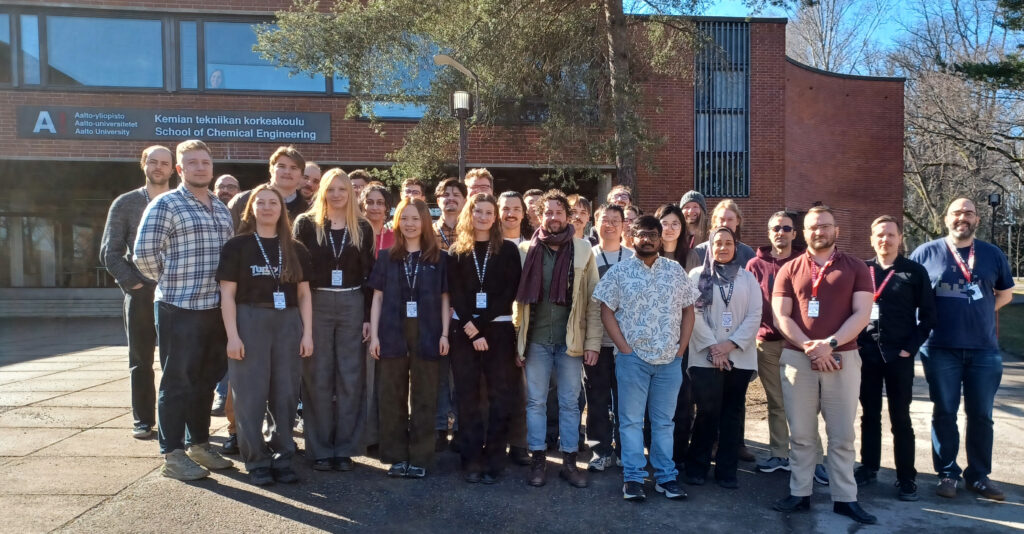
Motivation and overview
The field of atomistic ML has exploded in recent years. These models allow us to tackle materials modeling problems that were completely out of reach just a few years ago. Although most of the developments in this field have gravitated around ML interatomic potentials (MLPs), other properties which are a function of atomic coordinates, like core-electron binding energies, local electronic density of states, and so on, have also benefited from these developments. The software ecosystem has flourished in parallel with the methodological advancements. Unlike for DFT, where a few codes dominate, the MLP scene is fragmented due to the relative ease of producing functional code. While this might seem to be problematic, in practice it has helped drive many methodological advancements because the barrier to implementation of new features and experimental ideas is comparatively low and many more groups can participate.
The TurboGAP code (turbogap.fi) is developed at Aalto University by the Caro group, with support from CSC and participation of other local groups for specific features. The development of the code was initially motivated by the need for speeding up calculations based on GAP MLPs, but has since branched out; beyond-state-of-the-art methodologies in van der Waals corrections [PRB 111, 054103 (2025)] or inverse structure prediction [JACS 146, 14645 (2024); arXiv:2508.17132] have been developed and implemented within the TurboGAP development efforts. The code has full MPI support and a development branch, to be merged soon, has full MPI+GPU support. TurboGAP is, to our knowledge, the only MLP engine whose development is currently led by a Finnish institution. The purpose of this School is to gather the local community from Finnish higher-education and research institutions interested in MLP modeling of molecules and materials and introduce the general MLP methodology as well as the TurboGAP code specifically. The hope is that this will serve to both train local junior scientists in these new techniques and expand the TurboGAP user base, potentially also leading to new collaborations in development and applications. In addition, the School is keen to accept international attendees whose presence might contribute to these goals.
Participating in the School
The number of participants is limited to 20. Interested candidates can apply until 21 December 2025 at midnight (Finnish time) by following the link to the application form. The application form is very short, we only collect contact and institutional information as well as a brief motivation statement to participate. A maximum of 20 applicants will be invited by 31 December 2025 to participate and will have until 18 January 2026 to register. The registration is free of cost thanks to the financial support of CECAM-FI. If more than 20 applications are received, the selection of participants will be done by considering the motivation statement and trying to balance the participation from institutions across Finland and some representation from international institutions.
Program
All the lectures take place in room D311 (Ke 5) of the main building of the School of Chemical Engineering, Aalto University, Kemistintie 1, 02150 Espoo. The classroom is located on floor 3, one flight of stairs up from the buiding’s main entrance. The coffee and lunch breaks take place in an adjacent lobby.
All the hands-on sessions will be run within a JupyterLab virtual environment, Noppe, provided by CSC, the Finnish supercomputing center. The TurboGAP School’s lecturers have set up all the hands-on tutorials and you do not have to do any preparations to run the examples: just bring your own laptop, a web browser is enough. Instructions for using Noppe will be given to you during Session 2 of the School.
|
Monday 23 March
|
Tuesday 24 March
|
|
|
9:00-10:30
|
Session 1: Introduction to MLIPs and GAP (Miguel Caro)
|
Session 5: Radiation damage simulations (Ali Hamedani)
|
|
10:30-11:00
|
Coffee break
|
Coffee break
|
|
11:00-12:30
|
Session 2: Overview of the TurboGAP code, virtual environment for the hands-on session and basic example simulation (Miguel Caro & Tigany Zarrouk)
|
Session 6: Van der Waals corrections and their integration with MLIP (Heikki Muhli)
|
|
12:30-13:30
|
Lunch (catered)
|
Lunch (catered)
|
|
13:30-15:00
|
Session 3: Database curation and model training (Rina Ibragimova)
|
Session 7: Experimental observable prediction and reverse structure optimization: Molecular augmented dynamics (Tigany Zarrouk)
|
|
15:00-15:30
|
Break (smoothies)
|
Break (smoothies)
|
|
15:30-17:00
|
Session 4: Analysis and visualization of simulation results (Patricia Hernández-León)
|
Session 8: Grand canonical Monte Carlo simulations for variable-particle-number simulation (Alexis Front)
|
|
17:00-20:00
|
Social gathering at Masis Brewery (with pizzas, including vegan and vegetarian options)
|
The lecturers will be the TurboGAP development team, members of the Caro group, and collaborators:
- Prof. Miguel Caro (TurboGAP team PI)
- Dr. Tigany Zarrouk (TurboGAP lead developer)
- Dr. Rina Ibragimova
- Dr. Heikki Muhli
- Patricia Hernández-León
- Dr. Alexis Front
- Dr. Ali Hamedani
Participants
Trainees
| Name | Institution | |
| Biswarup Biswas | University of Turku | biswarup.biswas@utu.fi |
| Xiaoya Chang | Aalto University | xiaoya.chang@aalto.fi |
| Farshad Esmaeilian | University of Eastern Finland | farshad.esmaeilian@uef.fi |
| Leonardo Andres Espinosa Leal | VTT – Technical Research Center of Finland | |
| Artem Glova | Aalto University | artem.glova@aalto.fi |
| Aapo Haavisto | Aalto University | aapo.2.haavisto@aalto.fi |
| Adam Harmat | Aalto University | adam.harmat@aalto.fi |
| Hanan Ibrahim | University of Jyväskylä | hanan.h.ibrahim@jyu.fi |
| Rasmus Ikonen | University of Jyväskylä | rasmus.l.o.ikonen@jyu.fi |
| Aatif Imran | University of Turku | aatif.a.imran@utu.fi |
| Jyri Kimari | University of Helsinki | |
| Konstantinos Konstantinou | University of Turku | konstantinos.konstantinou@utu.fi |
| Tiago Lopes | University of Helsinki | tiago.lopes@helsinki.fi |
| Sanni Määttänen | Aalto University | sanni.maattanen@aalto.fi |
| Mario Mäkinen | Aalto University | mario.makinen@aalto.fi |
| Gianmarco Midena | Aalto University | gianmarco.midena@aalto.fi |
| Aneta Niklas | University of Oxford | aneta.niklas@chem.ox.ac.uk |
| Fatemeh Safari | University of Turku | fatemeh.f.safari@utu.fi |
| Nasrullah Sarker | University of Eastern Finland | nasarker@uef.fi |
| Timo Weckman | University of Jyväskylä | |
| Litong Wu | University of Oxford | litong.wu@jesus.ox.ac.uk |
| Yongchao Wu | Aalto University | yongchao.wu@aalto.fi |
DAS group members
| Name | Institution | |
| Reece Brooking | Aalto University | reece.brooking@aalto.fi |
| Yuto Iwasaki | Fujitsu Ltd. | ext-yuto.iwasaki@aalto.fi |
| Ondrej Krejci | Aalto University | ondrej.krejci@aalto.fi |
| Sampsa Mäenpää | Aalto University | sampsa.maenpaa@aalto.fi |
| Veera Mäkimartti | Aalto University | veera.makimartti@aalto.fi |
| Henrik Stenbrink | Aalto University | nilshenriksamuli.stenbrink@aalto.fi |
| Matias Vartiainen | Aalto University | matias.vartiainen@aalto.fi |
| Milona Weck | Aalto University | milona.weck@aalto.fi |
| Yucheng Zhang | Aalto University | yucheng.zhang@aalto.fi |
Lecturers
| Name | Institution | |
| Miguel Caro | Aalto University | miguel.caro@aalto.fi |
| Alexis Front | Aalto University | alexis.front@aalto.fi |
| Ali Hamedani | Aalto University | ali.hamedani@aalto.fi |
| Patricia Hernández-León | Aalto University | patricia.hernandezleon@aalto.fi |
| Rina Ibragimova | Aalto University | rina.ibragimova@aalto.fi |
| Heikki Muhli | Aalto University | heikki.muhli@aalto.fi |
| Tigany Zarrouk | Aalto University | tigany.zarrouk@aalto.fi |
Important dates
- 21 December 2025 – Deadline for applications
- By 31 December 2025 – Notification to selected participants
- 18 January 2026 – Deadline for registration of accepted participants
- 23-24 March 2026 – TurboGAP School 2026
Venue, transportation & accommodation
Venue

The conference will take place in the main campus of Aalto University, in the Helsinki metropolitan area. The venue is the Aalto University’s School of Chemical Engineering’s main building, Kemistintie 1, Espoo, 02150 Finland.
Getting there & around
 Aalto University is very well connected within the Helsinki metro area. The Otaniemi campus can be reached via metro (“Aalto University” stop) and the light rail (“Maari”, “Aalto-yliopisto” and “Otaranta” stops, from west to east). Please visit the website of HSL, the company operating the public transport system in the Helsinki metro area. This includes buses, the metro, trains, downtown trams, the light rail, and some municipal ferry services (e.g., to the Suomenlinna fortress island). Public transport in the Helsinki metro area is safe, clean and reliable. The easiest way to use the public transport system is to download the HSL app on your phone.
The Aalto University campus can be reached from Helsinki airport, e.g., by combining the train with the metro (changing at Helsinki’s Central Railway Station). Non-collective public transport options like taxis are also available, including popular apps like Uber; these are significantly pricier than collective transportations but might be more convenient depending on the situation (e.g., if you are in a hurry to reach the airport).
Accommodation
Aalto University is located on the Otaniemi campus. Otaniemi is a district of the city of Espoo, located within the Helsinki metropolitan area. There are various on-campus accommodation options in Otaniemi, for instance the Radisson Blu Espoo hotel. Since the Otanimi campus is connected to Helsinki by metro, and the commuting time is ~15 minutes from Helsinki city center, it is entirely possible to stay in Helsinki and commute every day to the School. This opens the door to a wider variety of accommodation options in terms of quality and price. Two options for on-campus accommodation are:
- Radisson Blu Espoo (from ~100 EUR/night)
- Heymo 1 by Sokos (from ~85 EUR/night)
For accommodation options in Helsinki, popular aggregators like Booking.com offer a “map-view” of the city and their user ratings are usually a good indicator of quality and value. If you opt for booking accommodation in Helsinki city center and commuting every day to the Aalto campus, we recommend that you reserve a hotel within walking distance of a metro station for convenience, e.g., stations “Ruoholahti”, “Kamppi”, “Central Railway Station”, etc.
Funding
The TurboGAP School 2026 is possible thanks to the financial support from CECAM-FI.
